
Key Takeaways
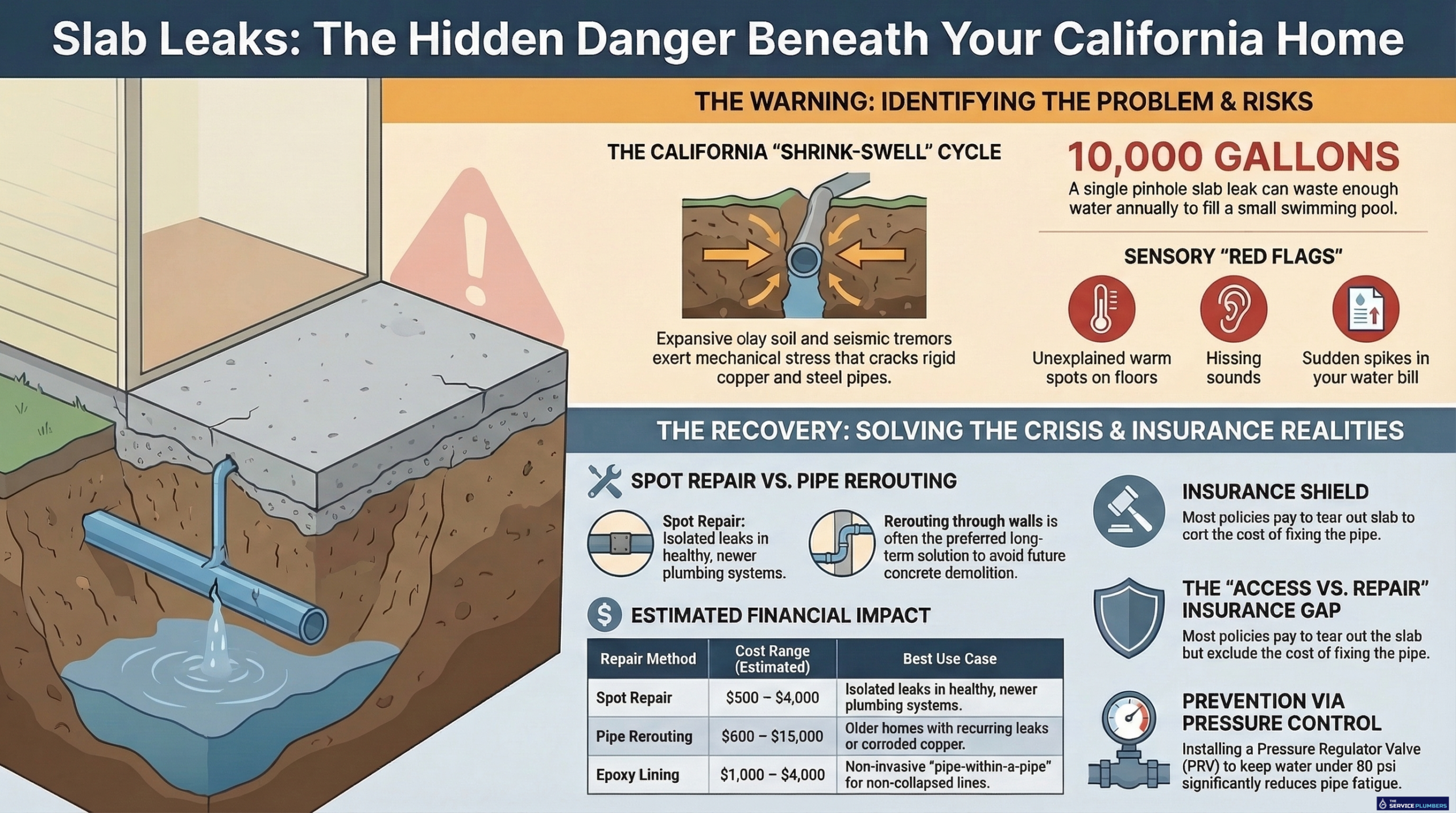
- California’s Unique Risk: Expansive clay soils and frequent seismic tremors place intense mechanical stress on underground pipes, making slab leaks a major threat to Southern California homes.
- Watch for Warning Signs: Unexplained water bill spikes, warm spots on the floor, hissing sounds, and sudden foundation cracks are major red flags of a hidden leak.
- Repair Options Vary by Age: Spot repairs work well for newer plumbing, but older, corroded systems often require full pipe rerouting or trenchless epoxy lining to prevent future damage.
- The Insurance “Access vs. Repair” Rule: Standard homeowners policies often pay to tear out the slab and restore the property, but exclude the actual cost of fixing the broken pipe.
- Prevention is Key: Installing a Pressure Regulator Valve (PRV) to keep water pressure below 80 psi significantly reduces pipe fatigue and the risk of future slab leaks.
A slab leak occurs when the pressurized water lines or drainage pipes buried beneath your home’s concrete foundation break, crack, or corrode. These hidden subterranean failures represent one of the most significant and costly threats to residential property in California.
Due to the state’s unique geological profile, homes in Southern California are disproportionately vulnerable to these issues. Frequent seismic tremors exert mechanical stress on rigid pipes, while the expansive clay soil undergoes a “shrink-swell” cycle—expanding when wet and contracting during droughts. This constant movement creates pressure differentials that can bend or fracture aging underground pipes, especially in homes built between the 1950s and 1980s using galvanized steel or copper.
Key Drivers of Plumbing Degradation
- Seismic Activity: Minor tremors cause foundations to shift independently of pipes, causing material fatigue at joints.
- Expansive Soil: Clay soil expansion crushes pipes, while drying removes support, causing pipes to bend.
- Corrosion and Hard Water: California’s hard water causes internal scale buildup and pitting corrosion, while soil chemistry can corrode pipes externally.
- High Water Pressure: Pressure exceeding the California code limit of 80 psi severely stresses pipe walls.
Identifying the Problem: Warning Signs of an Active Leak
Early detection is critical to preventing massive structural failure and astronomical water bills. A single pinhole slab leak can waste up to 10,000 gallons of water annually. Because these leaks are buried beneath concrete, they often go unnoticed until significant damage occurs.
Sensory and Structural Red Flags
- Unexplained Water Bill Spikes: A sudden, severe increase in your monthly water bill is often the first financial indicator.
- Sensory Clues: The sound of running or hissing water when all taps are off, or unexplained “warm spots” on your floor indicating a hot water line leak.
- Structural Damage: New cracks in walls, flooring, or the foundation, as well as sagging floors or warping wood.
- Hydraulic Drops: Sudden drops in water pressure or damp spots on carpets without an obvious source.
Modern advanced diagnostic methods—such as acoustic detection, thermal imaging, and tracer gas—allow professional plumbers to pinpoint these breaches without invasive demolition.
The Recovery: Repair Methodologies and Financial Impact
Once a slab leak is located, the right repair method depends on the pipe’s condition and your home’s architecture. Standard repairs average around $2,280, but complex rerouting or severe foundation damage can push costs past $15,000.
Common Repair Solutions
- Spot Repair ($500 – $4,000): Involves direct penetration of the slab to fix a specific pipe section. Best for isolated leaks in healthy, newer plumbing systems.
- Pipe Rerouting ($600 – $15,000): The underground line is bypassed by routing new pipes through the attic or walls. Often the preferred long-term solution for older homes to avoid future concrete demolition.
- Epoxy Pipe Lining ($1,000 – $4,000): A non-invasive “pipe-within-a-pipe” solution created by coating the interior of an existing, non-collapsed line with epoxy resin.
Understanding the “Access vs. Repair” Insurance Gap
Navigating homeowners insurance during a slab leak crisis can be complex. Standard policies (HO-3) generally follow a strict “Access vs. Repair” distinction regarding sub-slab plumbing failures.
- What is Covered: If the leak was “sudden and accidental,” insurance typically covers the cost to tear out the slab to reach the leak, as well as the cost to restore your drywall, flooring, and concrete afterward.
- What is Excluded: The cost to actually fix the broken pipe itself is usually considered a maintenance responsibility and excluded. Furthermore, gradual leaks, wear and tear, or damage from earth movement are typically not covered.
Homeowners should review their policies for optional “Service Line Coverage” endorsements, which can help cover the repair of aging underground lines.
Protect Your San Fernando Valley Home Today
California law requires that any high-stakes plumbing project exceeding $500 be performed by a CSLB-licensed plumbing contractor to ensure safety and code compliance. Ignoring the signs of a slab leak won’t make it go away; it will only increase your risk of severe foundation damage and mold growth.
Take strategic preventative steps today: install a Pressure Regulator Valve (PRV) to keep water under 80 psi and utilize smart leak monitors to catch continuous flow early. If you suspect you have a slab leak, do not wait for the damage to spread.
Call The Service Plumbers today for expert slab leak detection and repair in the San Fernando Valley. Our licensed technicians will accurately diagnose the issue and provide the most cost-effective, long-term solution for your home.